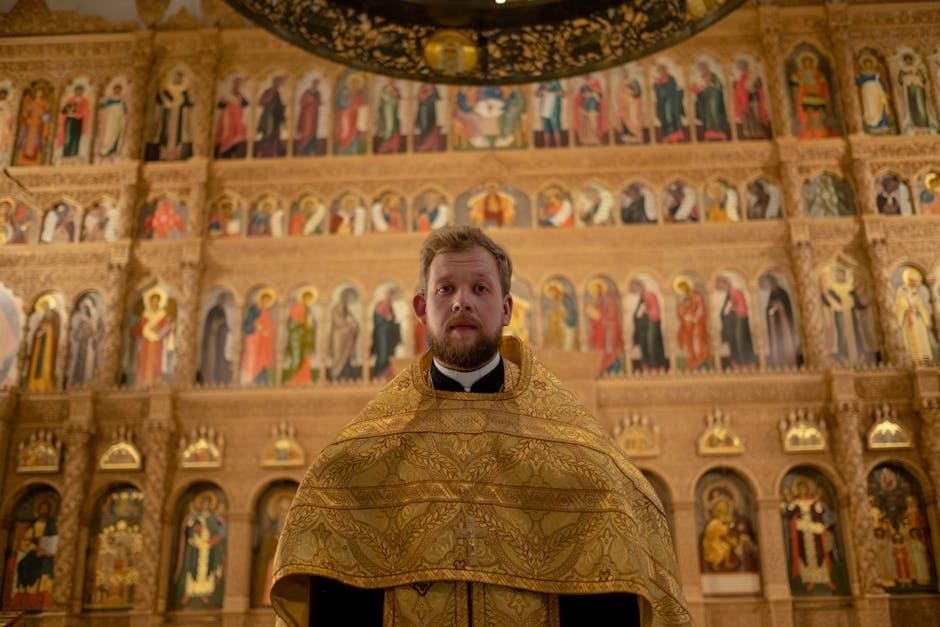
The sacred garments, known as bigdei kodesh, held immense significance, worn by Aaron and successive High Priests as commanded by scripture.
These vestments weren’t merely clothing; they were typological of Jesus Christ, embodying divine attributes and foreshadowing His priestly role.
Detailed studies, often found in PDF resources, explore the symbolism woven into each garment, revealing layers of meaning related to atonement and grace.
Historical Context and Significance
Historically, the High Priest’s garments weren’t simply ceremonial attire, but integral to the Israelite worship system, meticulously detailed in Exodus and Leviticus. Their initial consecration upon Aaron, and subsequent lineage through Eleazar, established a sacred tradition spanning generations.

The garments’ significance lay in their representation of holiness and mediation between God and the people. They weren’t self-created, but divinely ordained, emphasizing obedience and reverence;
Modern scholarship, often accessible through PDF studies, reveals the garments as a visual theology, embodying concepts of atonement, judgment, and divine grace. Understanding their historical context unlocks deeper layers of symbolism, connecting Old Testament rituals to the New Testament’s portrayal of Jesus as the ultimate High Priest, fulfilling the typological foreshadowing inherent in these sacred vestments.
The Biblical Basis: Exodus 28 & Leviticus 8-21
Exodus 28 provides the foundational blueprint for the High Priest’s garments, detailing each piece with precise instructions regarding materials, construction, and ornamentation. This chapter isn’t merely a tailoring guide, but a divine mandate for sacred vestments.
Leviticus 8-21 outlines the consecration rituals and regulations governing the priests, including stipulations regarding their attire. These chapters emphasize the garments’ role in maintaining holiness and mediating God’s presence.
Scholarly PDF resources demonstrate how these biblical passages reveal a deliberate symbolism embedded within each garment. The detailed descriptions aren’t accidental; they point to deeper theological truths. Studying these texts alongside commentaries unlocks a richer understanding of the garments’ purpose and their connection to the broader narrative of redemption and divine appointment.
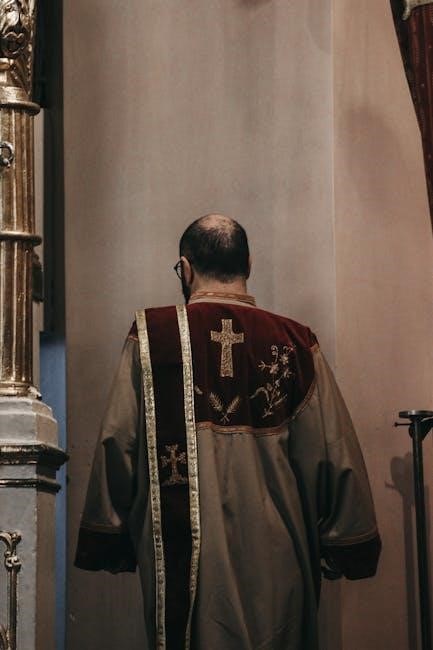
The Eight Garments of the High Priest
Eight distinct garments comprised the High Priest’s attire, each laden with symbolic meaning, meticulously detailed in ancient texts and explored in PDF studies.
These vestments represented holiness, authority, and a connection to the divine, as revealed through biblical accounts.
The Linen Undergarments
The foundation of the High Priest’s garments began with linen, representing purity and righteousness. These undergarments – the linen breeches and tunic – were worn directly against the skin, symbolizing a life lived in accordance with God’s standards. PDF resources detailing ancient temple attire emphasize the significance of linen as a material signifying holiness and separation from the world.
The breeches (Exodus 28:42) provided modesty and practicality, while the tunic (Exodus 28:40) served as a base layer for the more elaborate outer garments. These simple, white garments were particularly crucial on the Day of Atonement, when the High Priest entered the Holy of Holies, embodying humility and supplication before God. Scholarly articles available online further explore the symbolism of white linen as representing a cleansed and forgiven state, foreshadowing the purity required for approaching God’s presence.
The Linen Breeches (Exodus 28:42)
Essential for modesty and practicality, the linen breeches (Exodus 28:42) formed the foundational undergarment for the High Priest. Constructed entirely of woven linen, they covered the body from the waist to the thighs, ensuring appropriate attire during sacred duties. PDF studies of priestly vestments highlight the breeches’ role in maintaining a dignified and respectful appearance before God.
Symbolically, the breeches represent a covering for the lower body, potentially alluding to the control of earthly desires and a dedication to spiritual purity; Detailed diagrams found in scholarly resources illustrate the simple construction, emphasizing the focus on functionality and the material’s inherent symbolism. The linen itself, consistently associated with righteousness, underscores the High Priest’s need for a life lived in accordance with divine law, a concept explored in numerous theological texts.
The Linen Tunic (Exodus 28:40)
Worn over the linen breeches, the linen tunic (Exodus 28:40) was another foundational garment, also crafted from woven linen. This long, robe-like tunic extended to the wrists and ankles, providing full body coverage; PDF resources detailing ancient temple garments emphasize the tunic’s role in separating the High Priest from the common populace, signifying his consecrated status.
Symbolically, the tunic represents a covering of righteousness and purity, a visual declaration of the High Priest’s dedication to holiness. Scholarly articles suggest the tunic’s length symbolized complete devotion and humility before God. Diagrams available online illustrate the tunic’s simple design, highlighting the importance of the material itself – linen – as a representation of incorruptibility and divine favor. The tunic prepared the priest for the more ornate garments to follow.
The Embroidered Robe (Exodus 28:31-42)
The embroidered robe, or me’il, was a stunning garment of woven linen, intricately adorned with designs of pomegranates and golden bells along its hem (Exodus 28:31-42). Detailed PDF guides on High Priest vestments reveal the meticulous craftsmanship involved. Pomegranates symbolized fruitfulness and abundance, while the bells announced the High Priest’s movements in the Temple, signifying his presence before God.
Scholarly interpretations suggest the robe’s beauty reflected the glory of God. The golden bells, representing divine communication, echoed with every step. Resources highlight the robe as a symbol of joyful service and the proclamation of God’s blessings. Diagrams illustrate the precise arrangement of pomegranates and bells. This robe, worn over the tunic, prepared the High Priest for further sacred duties.
The Tekhelet (Blue) Dye and its Symbolism
The tekhelet, a vibrant blue dye extracted from a sea snail, was crucial in the High Priest’s garments, particularly the embroidered robe and the veil. PDF studies on priestly vestments detail the complex process of obtaining this dye, making it exceptionally valuable. Symbolically, tekhelet represented heaven, divinity, and God’s faithfulness.
The blue hue signified completion and the finished work of grace, mirroring Jesus Christ as the ultimate High Priest. Some interpretations link it to the expanse of the sky, reminding worshippers of God’s limitless power. Scholarly articles emphasize that the blue robe represents a work that will “never end,” a testament to eternal redemption. Diagrams in these resources illustrate where tekhelet was used, highlighting its importance.
The Outer Garments
The Me’il, a blue cloak, and the Ephod comprised the outer garments worn by the High Priest, signifying authority and glory. Detailed PDF resources showcase their construction and placement over the inner layers. The Me’il, entirely blue, lacked fringes or tassels, symbolizing a unique dedication to God. The Ephod, intricately woven with gold, represented the twelve tribes of Israel carried upon the High Priest’s shoulders.
Scholarly articles explain how these outer garments visually communicated the High Priest’s role as an intercessor between God and His people. Diagrams within these studies illustrate the precise arrangement of the Ephod’s chains and settings for precious stones. These garments weren’t merely decorative; they were potent symbols of divine service.
The Blue Cloak (Me’il) (Exodus 28:31-35)
The Me’il, a seamless, blue cloak, was a crucial outer garment for the High Priest, meticulously described in Exodus 28:31-35. PDF studies detail its construction from a single piece of woven fabric, signifying completeness and unity. Its vibrant blue color, derived from the tekhelet dye, symbolized heaven and God’s presence. Uniquely, it lacked tassels or fringes, differentiating it from other priestly garments.
Scholarly analyses within these resources highlight the Me’il’s symbolism of royal authority and divine majesty. The golden bells attached to its hem, resonating with each movement, proclaimed the High Priest’s approach to God. These PDF documents often include diagrams illustrating the cloak’s precise dimensions and placement, emphasizing its sacred significance.
The Ephod (Exodus 28:6-14)
The Ephod, a richly ornamented vest, was central to the High Priest’s attire, detailed in Exodus 28:6-14. PDF resources showcase its intricate construction, utilizing gold, blue, purple, and crimson threads, alongside precious stones. It wasn’t a full garment but rather a vest worn over the tunic, secured by a sash. Detailed diagrams within these studies illustrate the complex weaving and embroidery.
Symbolically, the Ephod represented the bearing of divine judgment and the priestly responsibility to intercede for Israel. Scholarly PDF analyses emphasize its connection to carrying the Urim and Thummim for discerning God’s will. The Ephod’s colors mirrored those of the Tabernacle, signifying a link between the priest and the sanctuary, a place of divine encounter.
The Breastplate of Judgment (Hoshen) (Exodus 28:15-28)
The Hoshen, or Breastplate of Judgment, was a stunning square garment, meticulously described in Exodus 28:15-28. PDF studies reveal it was crafted with gold, and adorned with twelve precious stones, each representing one of the tribes of Israel. These stones, set in gold filigree, symbolized the complete and unified nation before God.
Symbolically, the Breastplate represented the High Priest bearing the collective burdens and judgments of all Israel before the Lord. PDF analyses highlight its connection to righteous judgment and intercession. Crucially, it housed the Urim and Thummim, tools for seeking divine guidance, emphasizing the priest’s role as a conduit between God and His people. Detailed diagrams in these resources illustrate its construction.
The Urim and Thummim – Tools for Divine Guidance
The Urim and Thummim, nestled within the Breastplate of Judgment, were enigmatic objects used to discern God’s will. PDF resources dedicated to priestly vestments detail their function as tools for obtaining clear answers to specific questions posed before the Lord. Their exact nature remains debated, with theories suggesting they were stones, dice, or inscribed lots.
Symbolically, they represent God’s willingness to communicate with His people, but only through a consecrated intermediary – the High Priest. PDF analyses emphasize that the Urim and Thummim weren’t oracular devices, but rather instruments requiring faith and a sincere desire to know God’s direction. Diagrams within these studies illustrate their placement and potential forms.
Symbolism of the Garments
The High Priest’s garments were profoundly symbolic, typical of Jesus Christ, as detailed in numerous PDF studies. They represented divine attributes and foreshadowed His sacrifice.
Each element, from the colors to the materials, conveyed spiritual truths about God’s character and plan of redemption.
Representing Jesus Christ as the Great High Priest
The garments of the High Priest served as a powerful typology, prefiguring Jesus Christ as the ultimate Great High Priest. Scholarly PDF resources extensively detail this connection, highlighting how each vestment mirrored aspects of Christ’s character and ministry.
The white linen, worn on the Day of Atonement, symbolized purity and holiness, reflecting Christ’s sinless nature. The intricate embroidery and precious stones on the breastplate represented the perfection and multifaceted glory of God revealed in Jesus.
Furthermore, the act of the High Priest entering the Holy of Holies, mediated by the garments, foreshadowed Christ’s ultimate entry into heaven itself, offering a perfect and final sacrifice. These garments weren’t simply ceremonial; they were divinely ordained symbols pointing to the Messiah.
The Garments as a Typology of Divine Attributes
Detailed analyses, often available in PDF format, reveal how the High Priest’s garments weren’t merely decorative, but powerfully symbolized divine attributes. The blue tekhelet dye, for instance, represented heaven and God’s faithfulness, signifying a completed work of grace through Jesus.
The gold of the ephod and breastplate spoke of God’s glory and majesty, while the precious stones embodied the multifaceted nature of His character. Each element, from the linen undergarments to the outer cloak, pointed to specific aspects of God’s holiness, justice, and love.
These vestments served as a visual representation of God’s character, worn by the High Priest as he mediated between God and Israel, offering a tangible glimpse of the divine.
The Day of Atonement and White Linen Garments
Crucially, on the Day of Atonement, the High Priest exchanged his ornate garments for simple white linen, signifying humility and repentance. This shift, extensively documented in PDF studies of priestly vestments, represented a profound symbolic act.
The white linen symbolized purity and a complete reliance on God’s mercy, as the High Priest entered the Holy of Holies to atone for his own sins and those of the people. He appeared as a suppliant, stripped of earthly grandeur, acknowledging his unworthiness before God’s presence.
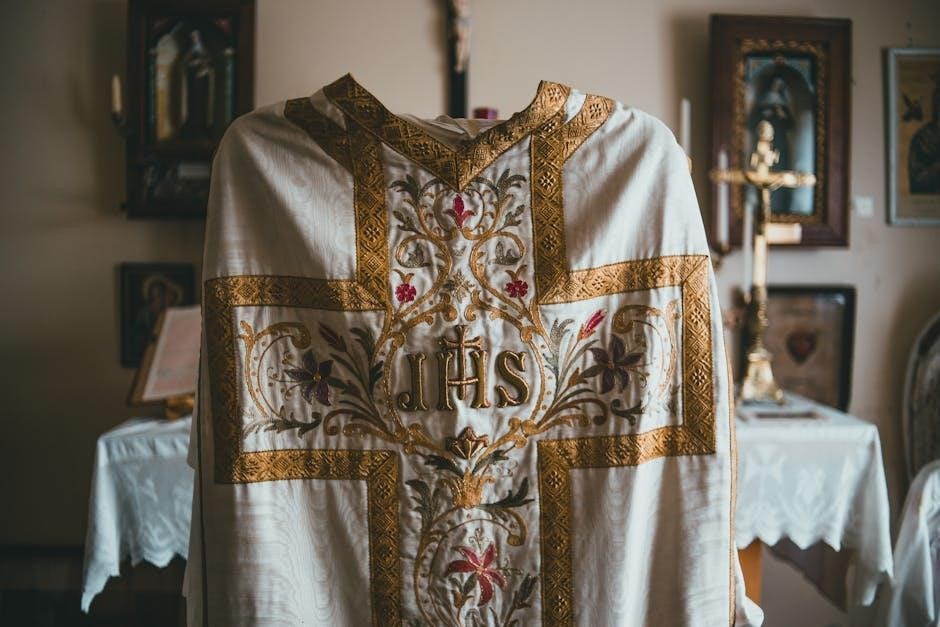
This practice foreshadowed the ultimate sacrifice of Jesus Christ, who humbled Himself and offered Himself as a pure and spotless lamb for the sins of humanity.

The Name of God and the High Priest’s Garments
Notably, a golden plate engraved with God’s sacred name adorned the High Priest’s mitre, as described by Josephus, detailed in PDF analyses.
This symbolized the High Priest acting with divine authority and representing God’s presence.
Engraved Plate on the Mitre

The mitre, or head covering, of the High Priest wasn’t simply a functional item but a powerful symbol of reverence and divine connection. Crucially, it bore a golden plate, known as the tzitz, inscribed with the Tetragrammaton – the sacred name of God, YHWH.
Scholarly PDF resources detail how this inscription wasn’t merely a name but a declaration of God’s presence and authority residing with the High Priest during sacred duties. Josephus’ historical accounts corroborate this practice, emphasizing the reverence surrounding these sacred letters.
The placement on the forehead signified that the High Priest’s thoughts and actions were to be directed towards God, and that he served as a conduit between the divine and the people. This act underscored the High Priest’s role as a representative of God’s holiness and justice.
Josephus’ Account of Sacred Letters
Flavius Josephus, the first-century historian, provides invaluable insight into the practices surrounding the High Priest’s garments, particularly the inscription of God’s name. His writings corroborate the biblical account of a golden plate affixed to the mitre, bearing the Tetragrammaton – YHWH – in sacred Hebrew letters.
Numerous PDF studies analyzing Josephus’ work highlight his detailed descriptions of these letters, emphasizing the profound reverence with which they were treated. He notes the meticulous care taken in their creation and placement, underscoring their sanctity.
Josephus’ testimony confirms that this wasn’t a common practice; the name was reserved solely for the High Priest’s mitre, signifying his unique position as the primary mediator between God and Israel. This historical corroboration strengthens the understanding of the garments’ symbolic weight.

Resources for Further Study (PDFs & Texts)
Detailed diagrams and scholarly PDF articles delve into priestly vestments, offering comprehensive analyses of the High Priest’s garments and their rich symbolism.
Explore these resources for in-depth understanding!
Availability of Detailed Garment Diagrams
Numerous resources provide meticulously detailed diagrams illustrating the High Priest’s garments, crucial for understanding their construction and symbolic weight. These visual aids, often available as PDF downloads, depict each of the eight garments – from the linen undergarments to the ornate outer vestments – with precision.
Researchers and students can access these diagrams to trace the intricate embroidery, the placement of the precious stones on the Breastplate of Judgment (Hoshen), and the specific design of the Ephod. Diagrams clarify the biblical descriptions found in Exodus 28 and Leviticus 8-21, offering a tangible representation of ancient Israelite craftsmanship.
Websites dedicated to biblical archaeology and Jewish history frequently host these visual resources, alongside scholarly articles that interpret the garments’ symbolism. These PDF documents often include cross-references to relevant scriptures, enhancing comprehension and facilitating deeper study.
Scholarly Articles on Priestly Vestments
Extensive scholarly research delves into the symbolism embedded within the High Priest’s garments, often published in academic journals and accessible as PDF documents. These articles explore the theological implications of each vestment, connecting them to concepts of atonement, holiness, and divine representation.
Researchers analyze the biblical text, historical context, and archaeological evidence to unravel the meaning behind the materials, colors, and ornamentation. Many articles focus on the tekhelet (blue) dye, linking it to the heavens and God’s presence. Others examine the Urim and Thummim, tools for divine guidance, and their connection to the Breastplate.
PDF databases and online libraries offer a wealth of these scholarly works, providing in-depth analysis of the garments’ role in ancient Israelite worship and their typological significance relating to Jesus Christ as the ultimate High Priest.